|
-_-_-_-_-
AUSTRALIA IN
BRIEF
|
 |
 |
Australia is the
largest island continent in the world with a coastline stretching 25,760
kilometres and an area of 7.7 million square kilometres. It is the vast
distances between population centres as well as the country's wide-open spaces
that, perhaps above all else, have the greatest impact on overseas visitors.
The most
recognisable image of Australia may be its outback. However, it is a country of
enormous geographical diversity. The landscape varies from the beautiful but
barren and harsh "red centre", to the lush tropical rainforest of north
Queensland, the green pastures of western districts of Victoria, to the
snowfields of the New South Wales and Victoria.
Despite such
diversity, it is essentially a dry, hot country and the greater part of the
interior is uninhabitable. The country's climate and consequent geography
largely explain its high level of urbanisation: the average Australian, instead
of wearing an Akubra hat and mustering cattle on a horse in the outback, is a
city dweller. The Australian population is estimated to be 22.8 million inhabits
a land area almost as big as continental USA. Over seven and a quarter million
people (around 40% of the entire population) live in Sydney and Melbourne. Other
major cities - Adelaide, Brisbane and Perth - all have population of more than 1
million.
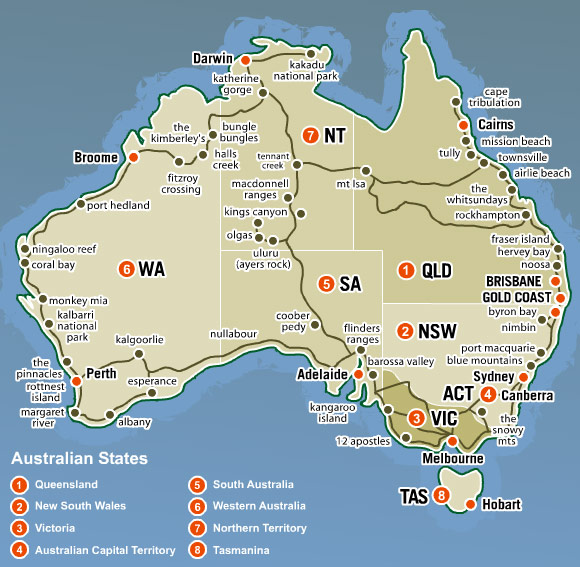
The country
is divided into six states - Victoria, New South Wales (NSW), Queensland, South
Australia, Western Australia and Tasmania, and two territories - the Australian
Capital Territory (ACT) and the Northern Territory. The capital city of each
state has a distinct identity, and it is the most populous two - Sydney in NSW
and Melbourne in Victoria, that can lay claim to being the country's most
sophisticated and cosmopolitan.
|
![[Company Logo Image]](images/logo.bmp)